
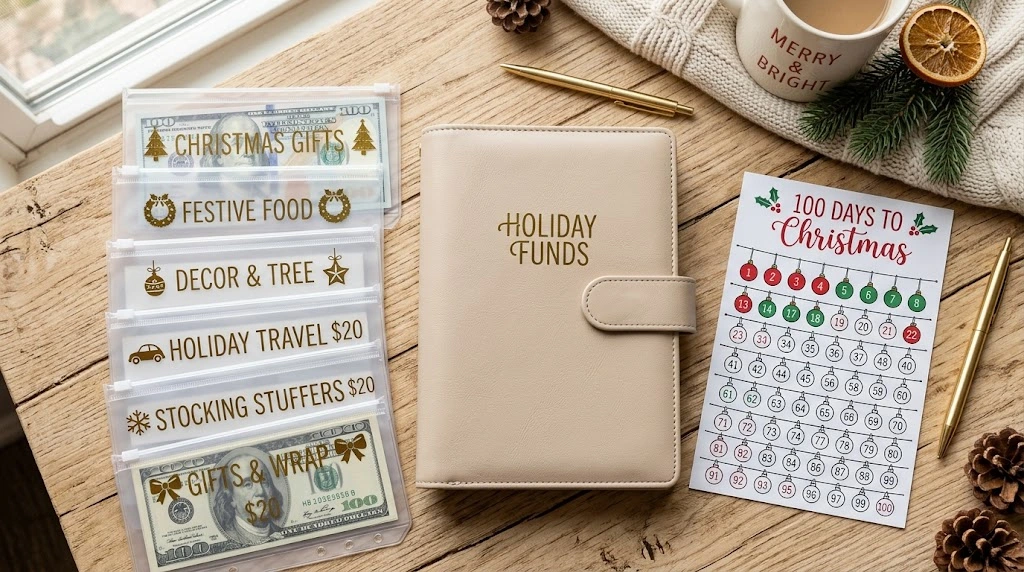
$1,000 Christmas Savings Challenge: Aesthetic Binder Setup Under $25 (100-Day Plan)
Starting a 100-day Christmas savings challenge is one of the most effective ways to reach a $1,000 holiday budget without taking on debt. Christmas expenses can pile up in a short time. Gifts, food, travel, decorations, and small purchases can create stress for a tight budget. A $1,000 goal may look difficult when your budget already feels limited. You do not need a large amount of cash at one time.
This 100-day Christmas savings challenge breaks the $1,000 goal into smaller amounts. An aesthetic binder under $25 can help you track each deposit. This guide covers the savings amounts, binder supplies, tracker ideas, and budgeting tips. You can use these ideas to build your Christmas fund through the 100-day challenge.
What is a 100-Day Christmas Savings Challenge (Complete Math Explained)
Saving for Christmas can feel difficult when you don’t know where to begin. This challenge breaks a $1,000 goal into smaller amounts over 100 days. It is suitable for anyone who wants a fixed Christmas savings target before holiday spending comes around.
Once you understand the daily and weekly numbers, this challenge becomes easy to achieve. So, let’s learn the math behind this 100-day challenge.
Save $10 Each Day
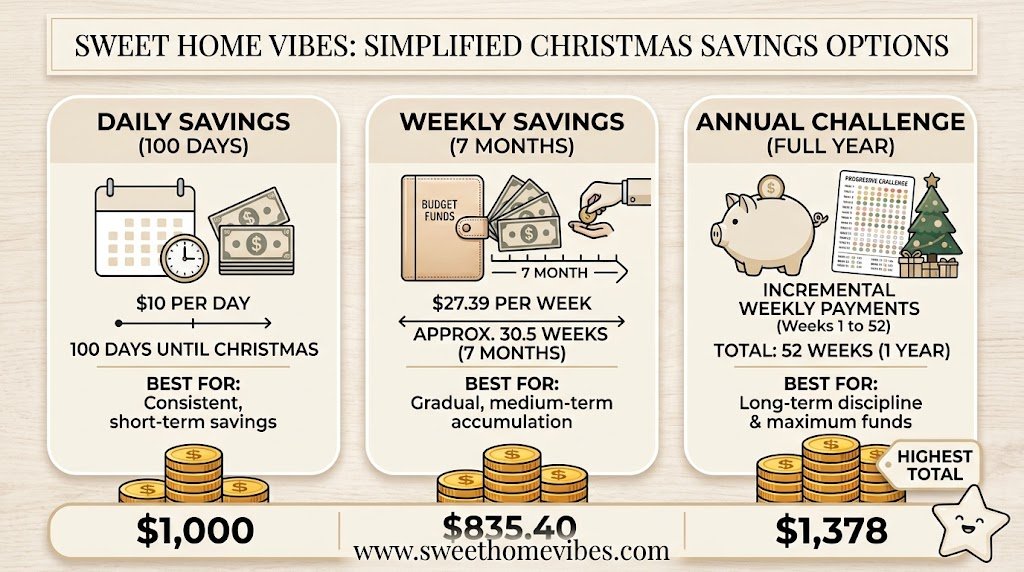
Divide $1,000 by 100 days, and you get a $10 daily target. A $10-a-day Christmas savings challenge breaks the full amount into daily savings. Put aside $10 each day to reach $1,000 in 100 days.
A 100-day Christmas savings challenge tracker helps you mark each completed deposit. You can see your progress as the days pass. This may motivate you to continue toward your Christmas goal.
Choose a Weekly Savings Amount
Some budgets may suit weekly deposits instead of daily savings. Divide $1,000 by about 36.5 weeks, and the weekly amount comes to $27.39. This clearly explains the question: “What is the 27-dollar rule for savings?”
A 100-day challenge and a weekly savings plan follow different timelines. Save $27.39 each week, and you reach $1,000 in about 36.5 weeks, or around 255 days. You may also save less each week. The trade-off is that you reach your $1,000 goal later.
Compare It With the 52-Week Challenge.
The 52-week Christmas savings challenge tracker uses a gradual weekly increase. Save $1 in week one, then increase the amount by $1 each week. After 52 weeks, your total reaches $1,378.
The 100-day plan uses one fixed daily amount instead. You save $10 each day rather than increasing the amount each week. This gives you a different timeline and a different savings pattern.
Reach $1,000 in 100 Days.
You can save 1000 for Christmas in 100 days by saving $10 each day. The math stays the same from day one through day 100. At the end of those 100 days, your total savings equal $1,000.
You may prefer to skip weekends and save around $14.30 each weekday. This option allows you to save on weekdays instead. Both methods target the same $1,000 Christmas goal.
Select a Suitable Savings Pattern
A flat $10 daily deposit gives you the same target each day. Some people may prefer larger deposits on the 1st and 15th. You can then use smaller amounts on the other days to match your budget.
This pattern is perfect for people who get paid twice a month. You can choose daily deposits, weekly deposits, or larger deposits on certain dates. The key goal is to reach $1,000 during your chosen savings period.
Essential Visual Elements for Cash Envelope Budgeting
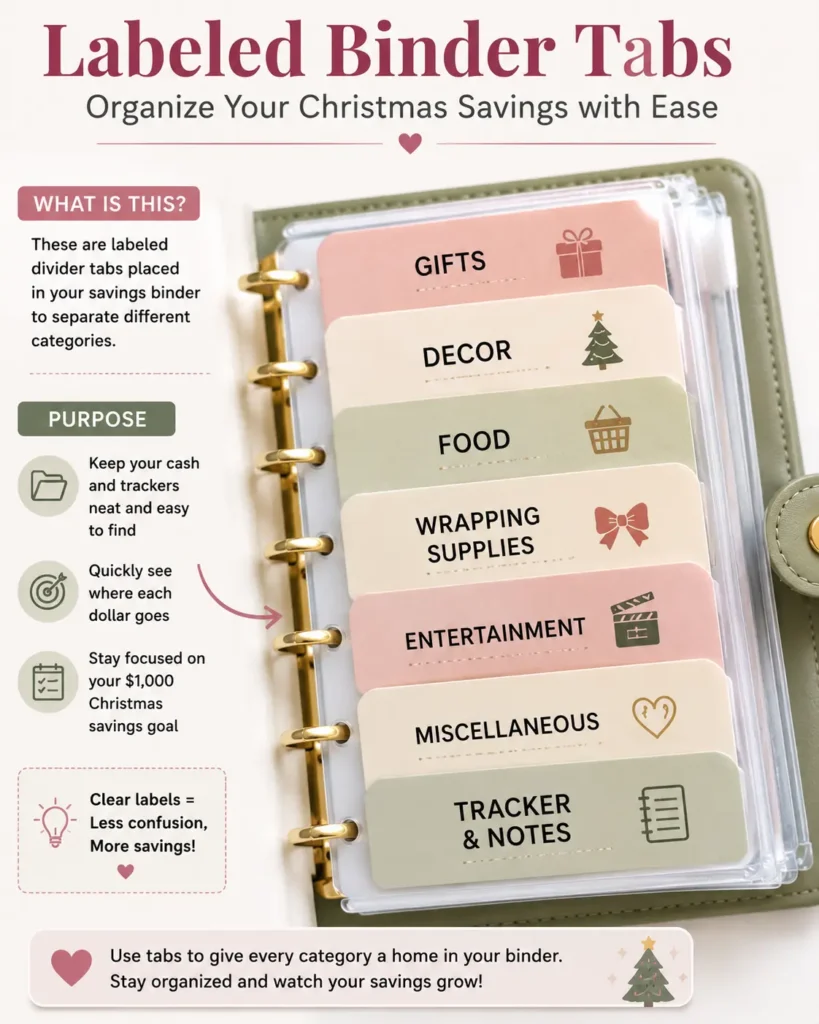
An aesthetic cash envelope Christmas budget can use three basic pieces: an A6-size binder, transparent PVC zip pouches, and tracker cards. Use one pouch for each cash group, such as gifts, decor, or food. Use tracker cards to record each deposit and expense. This setup can show where each dollar goes.
Then choose one consistent font for every label and card. Use a muted palette such as cream, beige, sage, or soft gray. Choose one accent color for small details. This style can make the binder look like a decor piece rather than a basic office folder.
Then choose a layout based on the way you plan to divide your cash. A weekly layout is also great for arranging cash by each week of the 100-day challenge. A category layout groups cash by gifts, decor, and food. This budget binder setup for holiday gifts can help sort cash by purpose.
If you have children, holiday spending can quickly spill over into year-round costs. To stay ahead of seasonal wardrobes, activities, and school costs alongside your Christmas prep, learn how to set up sinking funds for kids’ expenses.
The Under-$25 Amazon Budget Binder Setup
A Christmas savings binder does not have to cost much to organize your $1,000 goal. This Amazon shopping list brings the main binder supplies together in less than $25. This budget binder setup for Christmas 1000 dollars brings the main supplies together in one shopping list.
Each item has a specific role in your 100-day Christmas savings challenge. If you ask what the best cash envelope system binder setup under $25 is, this combination offers a low-cost choice. The Amazon picks below show each item, its price, and its purpose in your savings binder.
Sooez A6 PU Leather 6-Ring Budget Binder
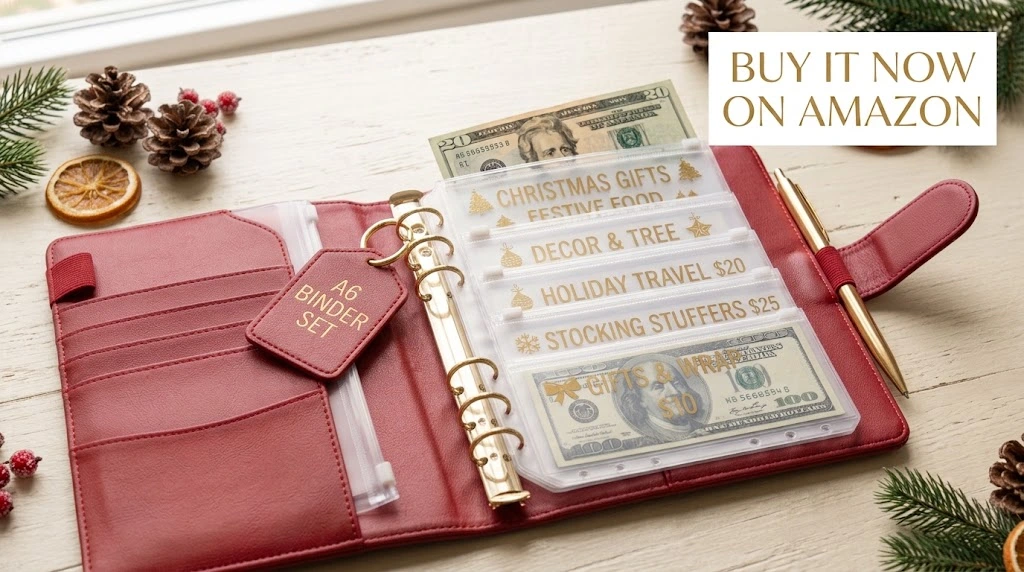
The Sooez A6 budget binder offers a compact base for a Christmas savings binder. It uses a PU leather cover and a six-ring design for A6 pages. The magnetic buckle closure keeps the binder closed between uses. Its size measures 7.48 × 5.2 inches, making it easy to store in a drawer or bag.
Choose this binder if you want a neat base for cash envelopes, savings trackers, and budget pages. The refillable design also lets you arrange pages around your $1,000 Christmas savings goal. Note that this listing includes the binder cover only, so zipper pouches and tracker cards come separately.
Antner 12-Pack A6 Clear Zipper Binder Pockets
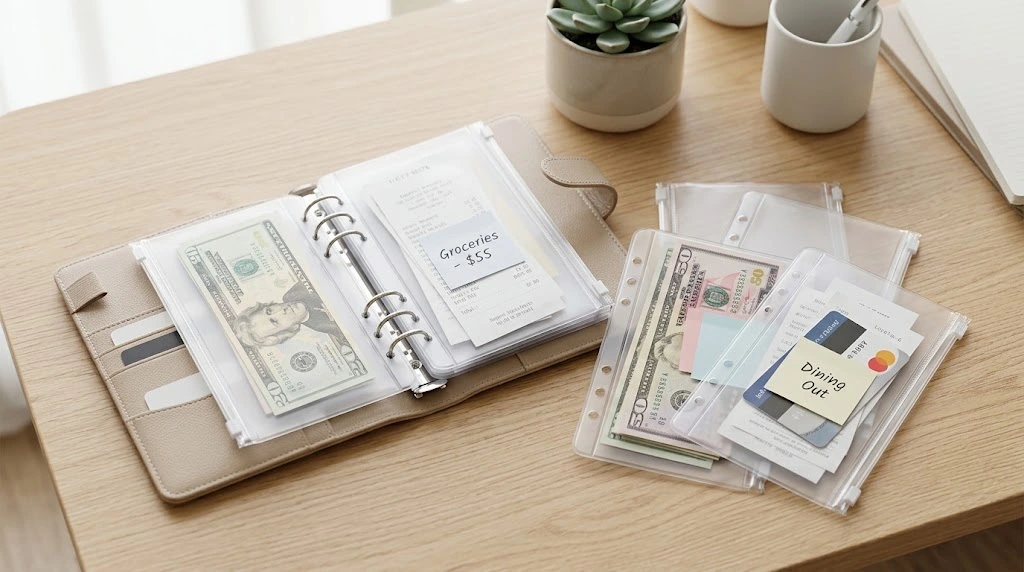
These Antner binder pockets provide a handy place for cash, receipts, coupons, notes, and other small items. Each A6 pocket has six holes and works with compatible 6-ring A6 binders. The pack includes 12 clear PVC pockets, so you can see the contents before you open each pouch.
Zipper closures help secure small items inside, and the water-resistant PVC material offers protection from spills. Choose these pockets if you want separate storage sections for budgeting, expense tracking, or everyday organization.
A6 Budget Expense Tracker Inserts
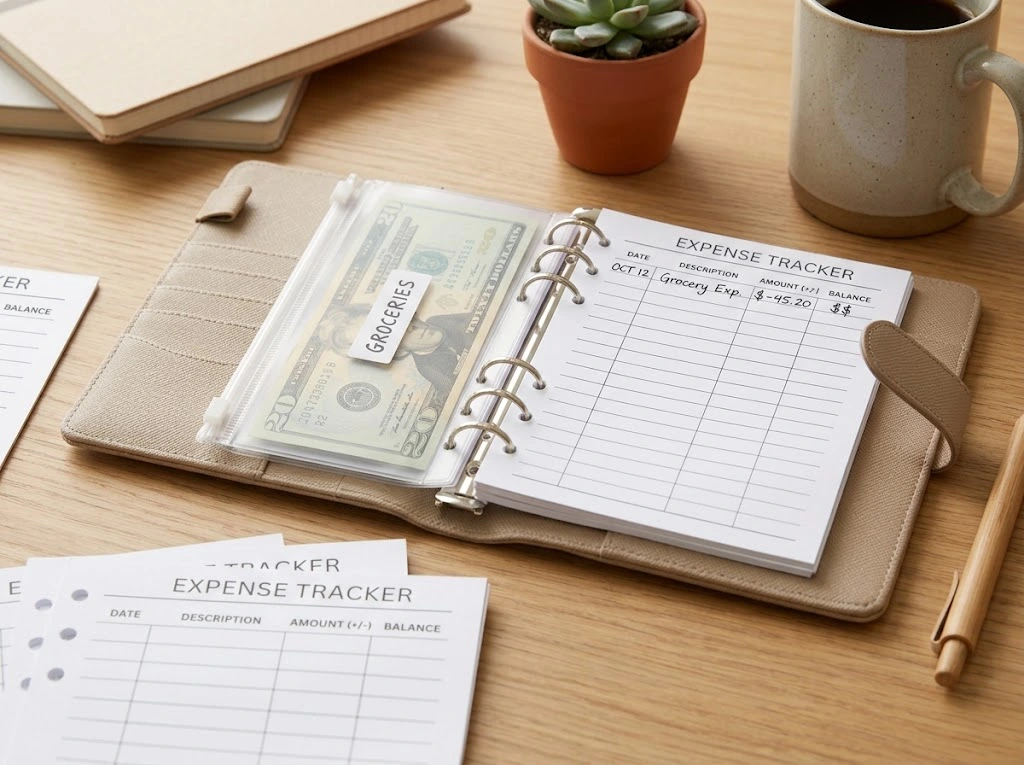
These A6 expense tracker sheets help you record money that enters or leaves each budget category. The six-hole layout suits compatible A6 budget binders, so you can place a tracker beside each cash envelope.
Write down deposits, purchases, and the remaining balance as you spend. The compact size also suits cash-envelope budgeting at home or on the go. Choose these inserts if you already use an A6 cash binder and want a paper record for categories such as groceries, bills, savings, or personal spending.
Free Printable Trackers and Digital Savings Alternatives
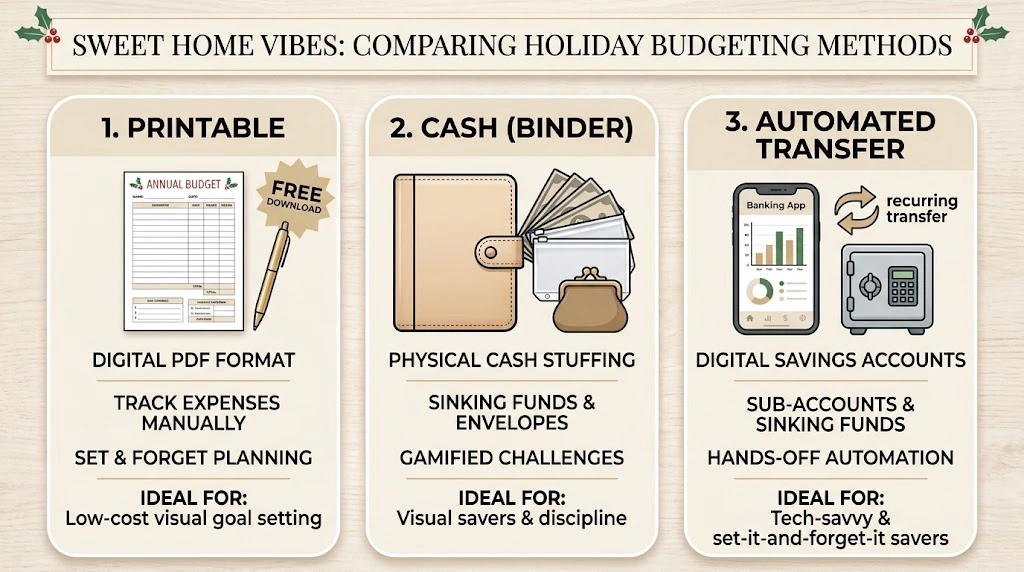
A Christmas savings plan does not require a paid tracker or cash binder. Free printables, cash envelopes, and bank transfers are three useful choices. Each option works differently for saving habits and spending awareness.
Free Printable Trackers
A free printable Christmas savings challenge binder offers a no-cost way to organize the plan. The main downside is less physical motivation from handling cash. You can download free Christmas savings trackers from personal finance blogs and printable sites. Print the tracker and place it inside your binder. Mark each deposit as you reach each savings goal.
( Download a free 100-day Christmas savings challenge tracker template here! )
Physical Cash Envelopes
A cash envelope system creates a stronger connection between your savings and expenses. A 100-day holiday cash envelope system provides each saving day with its own money task. The downside is the need to store and handle physical bills.
Digital Bank Transfers
Bank micro-transfers offer a good choice for people who prefer digital savings. Set a small transfer from each paycheck into a separate savings account. This method removes the need for cash envelopes or printed pages. The downside is less physical tracking during the savings challenge.
Each option offers a different saving experience. Choose the one that suits your budget and preferred money habits.
Practical Holiday Budgeting Strategies to Reach Your Goal
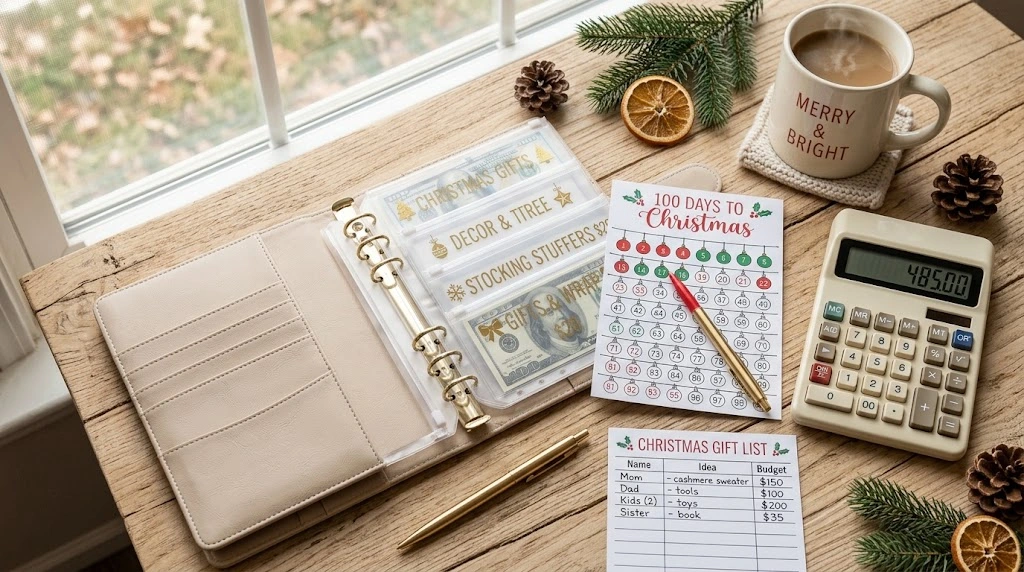
Holiday gifts can push a small budget off track very fast. A gift plan can help you control each purchase and protect your $1,000 goal. Choose a gift cap, track prices from October, and pause on any buy outside your list.
Choose a Gift Cap
Talk to larger family groups in October and agree on a $20 to $30 gift cap per person. This cap can limit gift costs and reduce pressure on each person. A shared cap can guide each person toward a suitable gift.
Track Gift Prices From October
Track gift prices from October rather than wait for one big shopping day. Note helpful deals in your binder and check each price again on purchase day. This habit can spread gift costs over several pay periods.
A $40 gift can become a shared gift among two or three people. Each person can pay a fixed amount toward the same item. This tactic can fit into a budget binder setup for Christmas 1000 dollars.
Use a 24-Hour Rule
Holiday displays can tempt you to buy items outside your gift list. Use a 24-hour wait rule for any purchase above $30 outside your list. Write the item and price in your binder, then review that cost the following day. If your budget can handle that item, make the final choice then.
Use Rewards on Gift Purchases
Pair a rewards or cash-back app with purchases already on your gift list. Check the app at the time of purchase and use an offer tied to that gift. Never buy an item just to earn a reward.
FAQs
What is the $27.39 rule for savings?
The $27.39 rule is a savings method where you save $27.39 each day. If you follow it for 100 days, you save $2,739. This makes $10,000 in total savings if you save this amount daily for the whole year (2365 days).
The idea is to use one fixed daily amount instead of deciding what to save each day. You can also adjust the amount or time period to match your own savings target.
How much does the 52-week savings challenge save?
A standard 52-week savings challenge can help you save $1,378 in one year. You save $1 in week one, $2 in week two, and increase the amount by $1 each week. By week 52, you save $52 that week.
If your goal is $1,000, you can use a smaller weekly amount or stop once your savings reach your target.
Is it possible to save $1,000 in 100 days?
Yes, it is possible to save $1,000 in 100 days. You need to save an average of $10 per day. That equals about $70 per week. If you follow that pace for 100 days, your total reaches $1,000.
What are effective strategies for a 100-day Christmas savings challenge?
Effective strategies for a 100-day Christmas savings challenge include saving $10 daily or about $70 weekly. Track each deposit and reduce unnecessary holiday spending. Use a savings binder to record your progress. These steps can help you reach the $1,000 goal within 100 days.
Where can I download free printable Christmas savings trackers?
You can find free printable Christmas savings trackers on budgeting websites and printable resource sites. You can access our interactive 100-day Christmas savings challenge tracker template to automatically calculate your daily progress toward your $1,000 goal, or print out a paper version for your budget binder.
How do I budget for Christmas gifts on a low budget?
Budget Christmas gifts by setting a $20–$30 limit per person and tracking gift prices starting in October. Share the cost of larger gifts among two or three people. Use a 24-hour rule for any unexpected purchase above $30.
What is the best cash envelope system binder setup under $25?
The best cash envelope binder setup under $25 can include a basic binder, zipper envelopes, category labels, and a spending tracker. Choose categories like groceries, gas, personal spending, gifts, and entertainment.